# How to Rename an Active Directory Domain Name

In this short article, we will show you how to properly change an Active Directory domain name from `test.com` to `resource.loc`. In fact, it is not the best idea to rename an Active Directory domain. In large and complex AD infrastructure, it is better to migrate users, computers, and servers to a new domain. However, for simple and small AD environments (test, pre-prod, or DMZ ), you can easily rename your AD domain according to this guide

Before you start, make sure that:

- You have an up-to-date [backup of your domain controllers](https://woshub.com/backup-active-directory-domain-controller/);
- Replication works correctly in your domain and there are no critical errors of domain controllers or DNS ([How to check Active Directory health](https://woshub.com/check-active-directory-health-and-replication/));
- There is no Exchange in your domain. You cannot rename an AD domain if Exchange is deployed in it (except for Exchange Server 2003);
- To rename a domain, you need Windows Server 2003 or newer (in my example, the functional level of my AD domain and forest is Windows Server 2016).

First of all, create a DNS zone for your new domain on your current domain controllers. To do it, open the dnsmgmt.msc snap-in, create a new primary **Forward Lookup Zone** with the name resource.loc and replicate it on all DNS servers in your old `test.com` domain.

You can create a new [DNS zone using PowerShell](https://woshub.com/create-manage-dns-zones-records-powershell/):

```
Add-DnsServerPrimaryZone -Name resource.loc -ReplicationScope "Domain" –PassThru
```

![1create-dns-primary-zone-for-new-ad-domain.png](https://wiki.mutschlerhome.com/walkthroughs/activedirectory/renamedomainname/1create-dns-primary-zone-for-new-ad-domain.png)

Wait till the new DNS zone is replicated on all DCs.

Run the `rendom /list` command to generate a **Domainlist.xml** file with the current AD forest configuration.  
![2rendom-list-command-used-to-generate-domainlist-x.png](https://wiki.mutschlerhome.com/walkthroughs/activedirectory/renamedomainname/2rendom-list-command-used-to-generate-domainlist-x.png)

```
Get-Content .\Domainlist.xml
```

```
<Forest>
<Domain>
<!-- PartitionType:Application -->
<Guid>6944a1cc-d79a-4bdb-9d1b-411fd417bbbc</Guid>
<DNSname>DomainDnsZones.test.com</DNSname>
<NetBiosName></NetBiosName>
<DcName></DcName>
</Domain>
<Domain>
<!-- PartitionType:Application -->
<Guid>bb10d409-4897-4974-9781-77dd94f17d47</Guid>
<DNSname>ForestDnsZones.test.com</DNSname>
<NetBiosName></NetBiosName>
<DcName></DcName>
</Domain>
<Domain>
<!-- ForestRoot -->
<Guid>b91bcb80-7cbc-49b7-8704-11d41b77d891</Guid>
<DNSname>test.com</DNSname>
<NetBiosName>TEST</NetBiosName>
<DcName></DcName>
</Domain>
</Forest>
```

Open the Domainlist.xml and replace all old domain names with the new ones:

```
Notepad .\Domainlist.xml
```

![3rename-the-domain-in-the-domainlist-xml-active-dir.png](https://wiki.mutschlerhome.com/walkthroughs/activedirectory/renamedomainname/3rename-the-domain-in-the-domainlist-xml-active-dir.png)

Save the file and run this command:

```
rendom /showforest
```

The command will show the changes to be made in the configuration.  
![4rendom-showforest-show-ad-configuration-changes.png](https://wiki.mutschlerhome.com/walkthroughs/activedirectory/renamedomainname/4rendom-showforest-show-ad-configuration-changes.png)

The following command will upload Domainlist.xml with the new configuration of AD partitions to the domain controller with the Domain naming master FSMO role:

```
rendom /upload
```

![6rendom-upload-upload-new-domain-name-to-ad.png](https://wiki.mutschlerhome.com/walkthroughs/activedirectory/renamedomainname/6rendom-upload-upload-new-domain-name-to-ad.png)

<p class="callout info">The [FSMO role owners](https://woshub.com/transfer-seize-fsmo-roles-in-active-directory/) can be displayed as follows:  
netdom query fsmo  
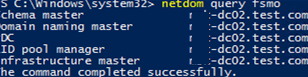
![7netdom-query-fsmo.png](https://wiki.mutschlerhome.com/walkthroughs/activedirectory/renamedomainname/7netdom-query-fsmo.png)</p>

After that, you won’t be able to make changes to the AD forest configuration because it will be locked.

The `rendom /prepare` command will check the availability of all DCs in the forest and if they are ready to be renamed.

Make sure that the command has not returned any errors.  
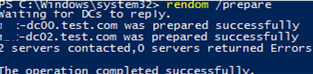
![8rendom-prepare-prepare-for-domain-renaming.png](https://wiki.mutschlerhome.com/walkthroughs/activedirectory/renamedomainname/8rendom-prepare-prepare-for-domain-renaming.png)

```
Waiting for DCs to reply.
mun-dc02.test.com was prepared successfully
mun-dc00.test.com was prepared successfully
The operation completed successfully.
```

The command below will rename the domain (domain controllers will be unavailable for some time and restarted automatically to apply new settings):

```
rendom /execute
```
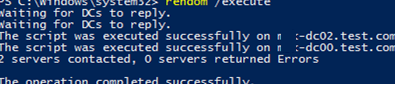
![9rendom-execute-apply-the-new-domain-name.png](https://wiki.mutschlerhome.com/walkthroughs/activedirectory/renamedomainname/9rendom-execute-apply-the-new-domain-name.png)

```
Waiting for DCs to reply.
The script was executed successfully on mun-dc02.test.com
The script was executed successfully on mun-dc00.test.com
2 servers contacted, 0 servers returned Errors
The operation completed successfully.
```

Make sure that the new domain name is displayed in the domain properties. Note that the full computer name did not change.  
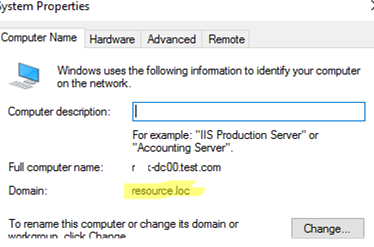
![10new-domain-name-in-the-computer-properties.png](https://wiki.mutschlerhome.com/walkthroughs/activedirectory/renamedomainname/10new-domain-name-in-the-computer-properties.png)

<p class="callout info">You must provide an account name in the format `newdomain\username` to login to the DC.  
To get to the DC, specify the account from the domain. On [Windows Core domain controllers](https://woshub.com/windows-server-core-install-active-directory-domain-controller/) you can specify a different username by pressing ESC several times.  

![11logon-to-dc-under-new-domain-account.png](https://wiki.mutschlerhome.com/walkthroughs/activedirectory/renamedomainname/11logon-to-dc-under-new-domain-account.png)</p>

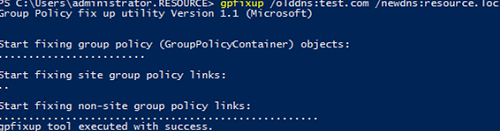
Run the following command to update GPO bindings:

```
gpfixup /olddns:test.com /newdns:resource.loc
```
![12gpfixup-fix-gpo-bindings.png](https://wiki.mutschlerhome.com/walkthroughs/activedirectory/renamedomainname/12gpfixup-fix-gpo-bindings.png)

```
Group Policy fix up utility Version 1.1 (Microsoft)
Start fixing group policy (GroupPolicyContainer) objects:
Start fixing site group policy links:
Start fixing non-site group policy links:
gpfixup tool executed with success.
```

Then update the NetBIOS domain name:

```
gpfixup /oldnb:TEST /newnb:RESOURCE
```

Then add new names on each domain controller manually and make them primary ones:

```
netdom computername %COMPUTERNAME%.test.com /add:%COMPUTERNAME%.resource.loc
netdom computername %COMPUTERNAME%.test.com /makeprimary:%COMPUTERNAME%.resource.loc
```

Restart the DCs:

```bash
Shutdown –f –r –t 0
```

<p class="callout warning">Only domain controllers need to be manually renamed. The rest of the computers and servers can be rebooted twice and they will automatically switch to the new domain.  
This must be done after /execute and BEFORE executing the rendom /clean command.  
  
Or you can use the commands above to rejoin computers to the new domain.  
</p>

The command below will remove links to your old domain from AD:

```
rendom /clean
```

Unlock the domain configuration:

```
rendom /end
```

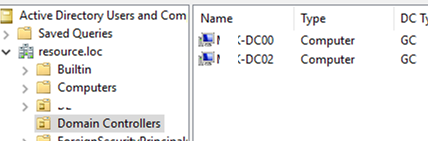
Open the [ADUC](https://woshub.com/install-active-directory-users-computers-aduc-console/) (`dsa.msc`) console and make sure that it has connected to the new domain name and all OU structure, users and computers remain in place.
![13domain-rename-completed-successfully.png](https://wiki.mutschlerhome.com/walkthroughs/activedirectory/renamedomainname/13domain-rename-completed-successfully.png)

<p class="callout info">Note that you will have to do some extra steps to re-configure some services (CA, Failover Clusters) to a new domain.</p>

After renaming your domain, check the AD replication state and errors on the DCs (see the link above).  
[Original Article](https://woshub.com/rename-active-directory-domain/)